



알레르기 비염: 치료
알레르기 비염의 치료원칙
- 4대 원칙: 원인 항원에 대한 회피, 약물 치료, 면역요법, 환자/보호자 교육
- 현실적으로 원인물질, 유발인자 등을 제거하거나 회피하는 게 쉽지 않으므로 알레르기 염증 및 증상 조절을 위한 약물치료가 치료의 중심
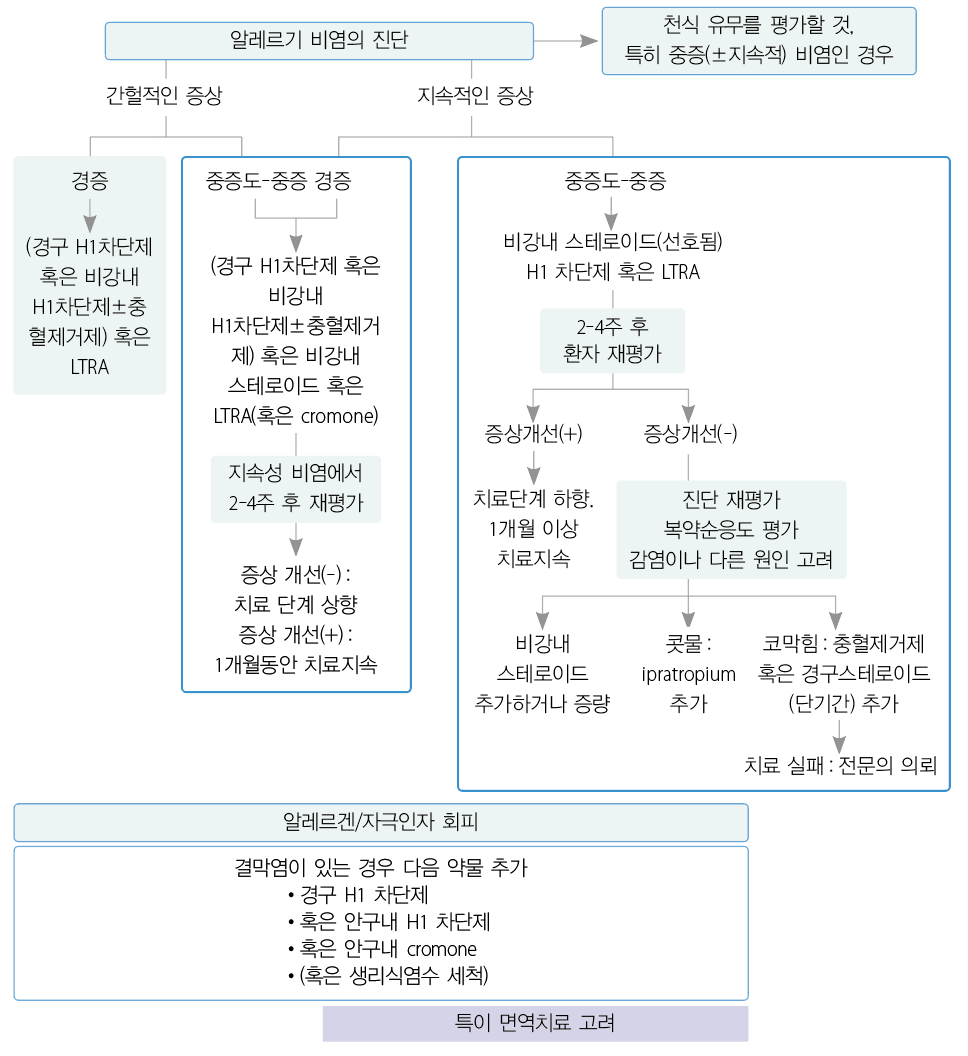
- 비염 치료지침인 ARIA (Allergic Rhinitis and its Impact on Asthma)에서는 치료방침을 다음과 같이 제시
알레르기비 염의 치료흐름도
회피요법
- 회피요법이란? 알레르기 비염이 면역반응이므로 원인물질(항원)과 자극물질에 노출되지 않도록 조심하는 것
- 그다지 효과적이지 않은 방법이지만 여러 비염치료지침에서는 알레르겐의 회피를 권장
국내 가이드라인
|
1. 방법
- 꽃가루항원에 대한 회피요법
- 4-6월: 나무계열 항원(오리나무, 자작나무, 개암나무, 느릅나무, 포플러나무, 은행, 참나무)
- 9-11월: 풀계열항원(쑥, 돼지풀, 비름, 환삼덩굴, 질경이)
- 꽃가루가 가장 많이 날리는 시간이 오전 5-10시이므로 특히 이 시간대는 피하는 것이 좋다
2. 효과
- 우리나라에 흔한 집먼지 진드기의 경우 일상생활 중에 항원에 대한 노출을 완벽하게 회피하는 것은 불가능하기 때문에 회피요법만으로 증상을 치유하기는 매우 어렵다.
- Cochrane review(2012년): 집먼지진드기의 노출을 상당히 줄여주면 비염증상 호전에 약간의 도움이 된다.
약물요법
알레르기비염 약물요법의 원칙
2008 ARIA guideline에서 중요 치료지침
|
알레르기 비염에 사용되는 약물
알레르기 비염의 치료약물
| 작용기전 | 부작용 | 비고 |
경구 H1 antihistamine | |||
2nd generation 1st generation | Blockage of H1 receptor Some antiallergic activity New generation drugs can be used once daily No development of tachyphylaxis | New generation No sedation for most drugs No anticholinergic effect No cardiotoxicity for products still available Acrivastine has sedative effects Mequitazine has an anticholinergic effect Oral azelastine may induce sedation and a bitter taste Old generation Sedation is common And/or anticholinergic effect | New generation oral H1-antihistamines should be preferred for their favorable efficacy/safety ratio and pharmacokinetics Rapidly effective (<1 h) on nasal and ocular symptoms Moderately effective on nasal congestion Cardiotoxic drugs are no longer marketed in most countries |
국소 H1-antihistamines(intranasal, intraocular) | |||
Azelastine Levocabastine Olopatadine | Blockage of H1 receptor Some antiallergic activity for azelastine | Minor local side effects Azelastine: bitter taste
| Rapidly effective (<30 min) on nasal or ocular symptoms |
비강 내 glucocorticosteroids |
|
|
|
Beclomethasone dipropionate Budesonide Ciclesonide Flunisolide Fluticasone propionate Fluticasone furoate Mometasone furoate Triamcinolone acetonide | Potently reduce nasal inflammation Reduce nasal hyperreactivity
| Minor local side effects Wide margin for systemic side effects Growth concerns with BDP only In young children consider the combination of intranasal and inhaled drugs | The most effective pharmacologic treatment of allergic rhinitis Effective on nasal congestion Effective on smell Effect observed after 12 h but maximaleffect after a few days |
전신 glucocorticosteroids(경구/근육 내) | |||
Dexamethasone Hydrocortisone Methylpredisolone Prednisolone Prednisone Triamcinolone | Potently reduce nasal inflammation Reduce nasal hyperreactivity
| Systemic side effects common in particular for IM drugs Depot injections may cause local tissue atrophy | When possible, intranasal glucocorticosteroids should replace oral or IM drugs However, a short course of oral glucocorticosteroids may be needed if moderate/severe symptoms |
국소 cromones (intranasal, intraocular) | |||
Cromoglycate Nedocromil
| Mechanism of action poorly known | Minor local side effects | Intraocular cromones are very effective Intranasal cromones are less effective and their effect is short lasting Overall excellent safety |
경구 비충혈제거제 | |||
Ephedrine Phenylephrine Phenyl propanolamine Pseudoephedrine Oral H1-antihistamine– decongestant combinations | Sympathomimetic drugs Relieve symptoms of nasal congestion | Hypertension. Palpitations Restlessness, Agitation Tremor, Insomnia Headache Dry mucous membranes Urinary retention Exacerbation of glaucoma or thyrotoxicosis | Use oral decongestants with caution in patients with heart disease Oral H1-antihistamine–decongestant combination products may be more effective than either product alone but side effects are combined |
비강 내 비충혈제거제 | |||
Oxymethazoline Xylomethazoline Others | Sympathomimetic drugs Relieve symptoms of nasal congestion | Same side effects as oral decongestants but less intense Rhinitis medicamentosa is a rebound phenomenon occurring with prolonged use (over 10 days) | Act more rapidly and more effectively than oral decongestants Limit duration of treatment to <10 days to avoid rhinitis medicamentosa |
비강 내 항콜린제 | |||
Ipratropium | Anticholinergics block almost exclusively rhinorrhoea | Minor local side effects Almost no systemic anticholinergic activity | Effective on allergic and nonallergic patients with rhinorrhoea |
Leukotriene antagonists | |||
Montelukast Pranlukast Zafirlukast | Block CystLT receptor | Excellent tolerance | Effective on rhinitis and asthma Effective on all symptoms of rhinitis and on ocular symptoms |
- 다음과 같은 약제 또한 알레르기 비염에서 사용될 수 있다.
- Local cromones (intranasal, intraocular)
- Intranasal anticholinergics
알레르기 비염의 치료제의 효능에 대한 근거(ARIA 가이드라인)
Intervention | SAR | PAR | PER | ||
adult | children | adult | children | ||
oral H1 Antihistamine | A | A | A | A | A |
Intranasal H1 Antihistamine | A | A | A | A | A |
Intranasal CS | A | A | A | A | A |
Intranasal cromone | A | A | A | A |
|
LTRAs | A | A(>6세) | A |
| A |
Subcutaneous SIT | A | A | A | A | A |
Sublingual / nasal SIT | A | A | A | B | A |
Allergen avoidance | D | D | A | B |
|
SAR(seasonal allergic rhinitis), PAR(perennial allergic rhinitis), PER(persistent allergic rhinitis), CS(corticosteroid), LTRAs(anti-leukotrienes), SIT(specific immunotherapy)
알레르기 비염에 사용되는 주요 약물
종류 | 증상별 추천 | 알레르겐 노출 상황별 추천 | 증상빈도별 추천 | 중증도별 추천 | |||||||
비충혈 | 콧물 | 재채기 | 코 가려움증 | 계절성 | 통년성 | Episodic | 간헐적 | 지속적 | 경증 | 중증 | |
비강 내 스테로이드 | +++ | +++ | +++ | +++ | ++ | ++ | + | ++ | ++ | ++ | ++ |
경구 항히스타민 | + | ++ | ++ | ++ | + | + | + | ++ | + | + | 비추천 |
비강 내 항히스타민 | ++ | ++ | ++ | ++ | ++ | + | ++ | ++ | + | ++ | + |
류코트리엔억제제 | + | + | + | + | + | + | 비추천 | 비추천 | 추천함 | 추천함 | 단독요법으로는 추천 안함 |
별표는 상대적인 효능을 나타낸다. +++, ++, + 순으로 효능의 정도를 표시한다. 예를 들어 비충혈에 +++이고 다른 증상에 +라면 비충혈에 가장 효과적이고 다른 증상에도 역시 효과적임을 의미
| 국외 | 국내 |
항히스타민제 | 2010 ARIA 가이드라인 지침
미국 이비인후과학회(2015년)
|
|
류코트리엔 수용체 길항제(LTRA) | 2010 ARIA 가이드라인 지침
미국 이비인후과학회(2015년)
|
|
비강 내 스테로이드제 | 2010 ARIA 가이드라인 지침
미국 이비인후과학회(2015년)
|
|
스테로이드 점안액 | 국내 가이드라인
| |
전신스테로이드(경구, 주사) | 2010 ARIA 가이드라인 지침 전신적 스테로이드제는 국소 스테로이드제나 항히스타민제에 반응하지 않는 심한 코막힘이 있는 환자에서 단기간에만 사용한다.
|
|
혈관수축제 | 2010 ARIA 가이드라인 지침
|
|
기타 약물 | chromones(intranasal, intraocular) - 2010 ARIA 가이드라인 지침
intranasal ipratropium Bromide - 2010 ARIA 가이드라인 지침
| |
약물 치료의 실제
- ARIA에서 제시하는 단계별 약물치료는 다음과 같다.
알레르기 비염 단계별 약물치료
단계 | 추천되는 치료 |
Mild IAR |
|
Moderate/severe IAR |
|
Mild PER |
|
Moderate/severe PER |
|
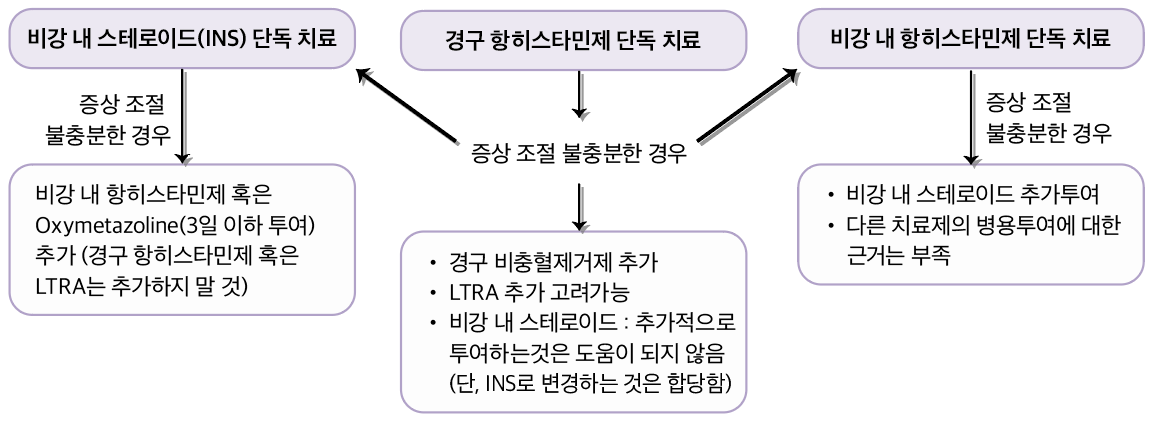
알레르기 비염 약물 치료 흐름도(미국이비인후과학회, 2015)
면역요법
2010 ARIA 가이드라인 지침 | 국내 가이드라인 |
|
|
알레르겐 면역요법이란?
개요
- 원인 알레르겐을 소량씩부터 증량하면서 인체에 노출시켜 면역조절과 관용을 유도하는 치료
- 가장 근본적인 알레르기 비염 치료방법
- 회피요법과 약물치료에 효과가 없을 때 시행; 항원 회피가 불가능하면서 원인 항원 노출과 증상 발현의 인과 관계가 확실한 경우에 시행
효과
- 꽃가루, 집먼지진드기, 반려동물털, 일부 곰팡이에 의한 알레르기 비염에서 증상 완화/소실 유도; 새로운 알레르겐에 대한 추가 감작과 천식 발생 예방
방법
- 피하주사 면역요법(subcutaneous immunotherapy)
- 설하면역요법(sublingual immunotherapy): 최근 효능과 안전성이 입증되어 점차 시행 증가; 피하면역요법만큼 효과적; 피하면역요법에 비해 전신 부작용이 적어 비교적 안전
- 비강 내 면역요법(intranasal immunotherapy)
치료의 실제
- 알레르겐의 선택
- 병력 청취, 피부단자시험 혹은 특이 IgE 항체검사를 통해서 원인 알레르겐 노출과 증상 간의 연관성이 증명된 알레르겐 선택
- 효과가 입증된 알레르겐: 나무/잔디/잡초 꽃가루와 집먼지진드기, 동물털, 일부 곰팡이
- 다수의 알레르겐에 감작된 경우 한 종류 혹은 가능한 적은 숫자의 알레르겐을 포함시킬 것
- 치료기간: 최소 3~5년 이상
수술
- 적절한 치료에도 호전되지 않는 경우, 하비갑개의 비대가 심하여 코막힘 증상이 심한 경우 하비갑개의 부피를 축소시키기 위한 수술 고려
- 알레르기 비염 환자에서 비중격만곡이 동반되어 있을 경우 비갑개 수술과 함께 비중격교정술 고려
참고자료
- 김철우. 알레르기비염의 최신 지견. 대한내과학회지 2012;82(3):298–303.
- Bousquet J, Khaltaev N, Cruz A, et al. Allergic Rhinitis and its Impact on Asthma (ARIA) 2008 update (in collaboration with the World Health Organization, GA (2) LEN and AllerGen). Allergy 2008;63:8.
- Roberts G, Xatzipsalti M, Borrego LM, et al. Paediatric rhinitis: position paper of the European Academy of Allergy and Clinical Immunology. Allergy 2013;68(9):1102–16.
- 대한천식알레르기학회. 임상의를 위한 진료가이드라인: 알레르기비염. 2015
- Kim YH, Kim M-A, Yang H-J, et al. Crinical diagnostic guidelines for allergic rhinitis: medical treatment. Journal of the Korean Medical Association 2017;60(2):183–93.
- 김영훈, 김경수. 알레르기비염의 진단과 치료. 대한의사협회지 2010;53(9):780–90.
- Nurmatov U, van Schayck CP, Hurwitz B, Sheikh A. House dust mite avoidance measures for perennial allergic rhinitis: an updated Cochrane systematic review. Allergy 2012;67(2):158–65.
- Bousquet J, Reid J, Van Weel C, et al. Allergic rhinitis management pocket reference 2008*. Allergy 2008;63(8):990–6.
- Seidman MD, Gurgel RK, Lin SY, et al. Clinical practice guideline: Allergic rhinitis. Otolaryngol Head Neck Surg 2015;152(1 Suppl):S1–43.
- Brozek JL, Bousquet J, Baena-Cagnani CE, et al. Allergic Rhinitis and its Impact on Asthma (ARIA) guidelines: 2010 revision. J Allergy Clin Immunol 2010;126(3):466–76.
- Kim YH, Lee SM, Kim M-A, et al. Clinical diagnostic guidelines of allergic rhinitis: comprehensive treatment and consideration of special circumstances. Journal of the Korean Medical Association 2017;60(3):257–69.